The Invisible "Stethoscope": A Deep Dive into Laser Doppler Vibrometer (LDV)
Vibration tells a story. The subtle tremor of a bridge under traffic hints at structural fatigue. The screech of automobile brakes reveals resonance gone wrong. In engineering, capturing these signals is essential—but traditional tools have a fundamental limitation.
Accelerometers require physical contact. Attach one to a MEMS gyroscope (lighter than a grain of sand), a delicate biological membrane, or a spinning turbine blade, and you face a dilemma: either mounting is impossible, or the sensor’s own mass distorts the measurement—a problem known as “mass loading.”
The Laser Doppler Vibrometer (LDV) solves this elegantly. Acting as an “invisible stethoscope,” it uses a beam of light to sense motion from a distance—no wires, no contact, no added mass—achieving picometer-level precision on objects from microscopic sensors to towering skyscrapers.
The Core Physics: How Does LDV Work?
The magic of LDV relies on three concepts: The Doppler Effect, Interferometry, and Heterodyne Detection.
Key Principle
Movement changes the frequency of light (Doppler). By comparing the reflected light with a stable reference beam (Interferometry), we can measure velocity with extreme precision.
Visualizing the Optical Path
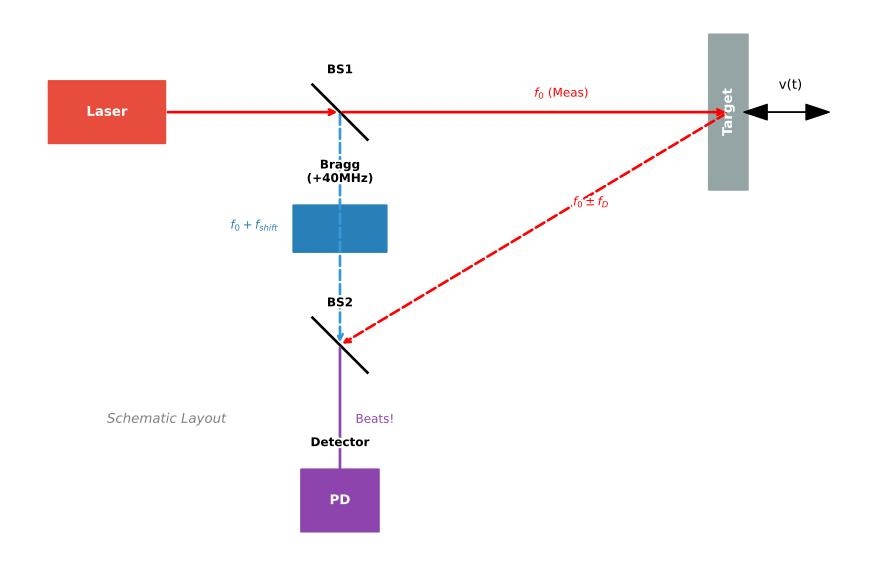
Before diving into equations, let’s visualize how the light travels inside the device using a simplified Mach-Zehnder interferometer setup:
The Doppler Effect
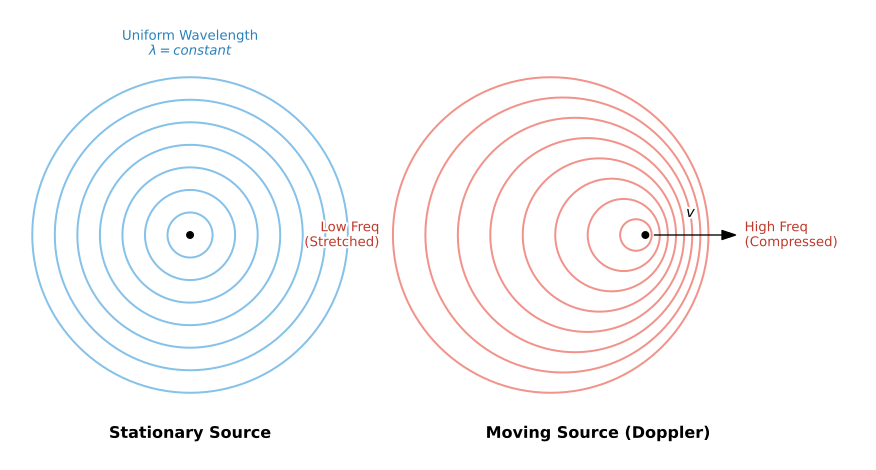
You experience this daily. When an ambulance drives towards you, its siren sounds higher pitched; as it moves away, the pitch drops. Light behaves the same way.
When the laser beam hits a moving surface, the reflected light’s frequency shifts. The shift ($f_D$) is proportional to velocity ($v$):
$$f_D = \frac{2 \cdot v}{\lambda}$$
where $\lambda$ is the laser wavelength (typically 633 nm for He-Ne lasers).
Numerical Example
For a He-Ne laser ($\lambda = 633$ nm) measuring a surface moving at $v = 1$ mm/s: $$f_D = \frac{2 \times 0.001}{633 \times 10^{-9}} \approx 3.16 \text{ kHz}$$ This frequency is easily measurable by standard electronics.
Optical Interferometry
Light frequency is incredibly high ($\approx 4.74 \times 10^{14}$ Hz)—far too fast for any electronic detector to count directly.
To solve this, LDV uses interferometry.
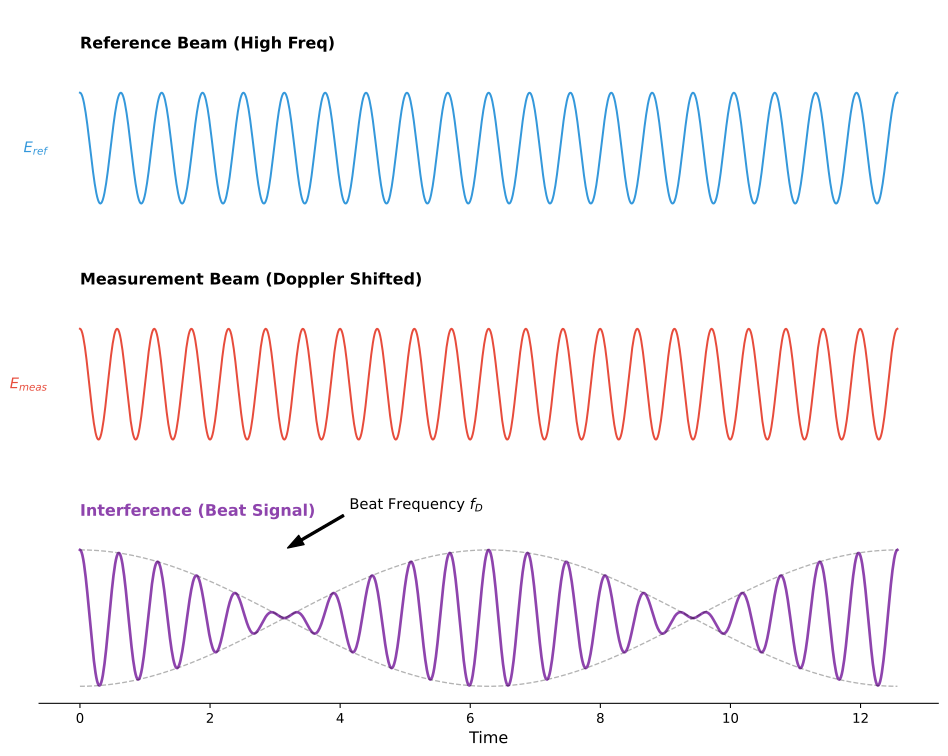
- The Reference Beam stays inside the device.
- The Measurement Beam travels to the target and returns.
When these two mix at the detector, they “interfere.” If they are in phase, they get brighter (constructive); if out of phase, they get darker (destructive). As the target moves, this brightness oscillates, creating a “beat frequency” that equals the Doppler shift ($f_D$). This beat frequency is low enough for electronics to process.
Determining Direction (Heterodyne Detection)
A standard interferometer has a “blind spot”: it can’t tell if an object is moving towards or away from you—it only sees speed (absolute frequency change). This is because $|+f_D|$ and $|-f_D|$ both produce the same beat frequency.
To fix this, modern LDVs use a Bragg Cell (Acousto-Optic Modulator) to pre-shift the reference beam frequency by exactly 40 MHz (a common industrial standard). This creates an “offset” baseline:
| Target Motion | Detected Frequency | Interpretation |
|---|---|---|
| Stationary | 40.000 MHz | No velocity |
| Moving Towards | 40.001 MHz (+1 kHz) | Positive velocity |
| Moving Away | 39.999 MHz (−1 kHz) | Negative velocity |
Think of it like tuning a radio: the 40 MHz is the “carrier wave,” and the vibration signal is the FM modulation riding on top of it.
System Configuration: What’s Inside?
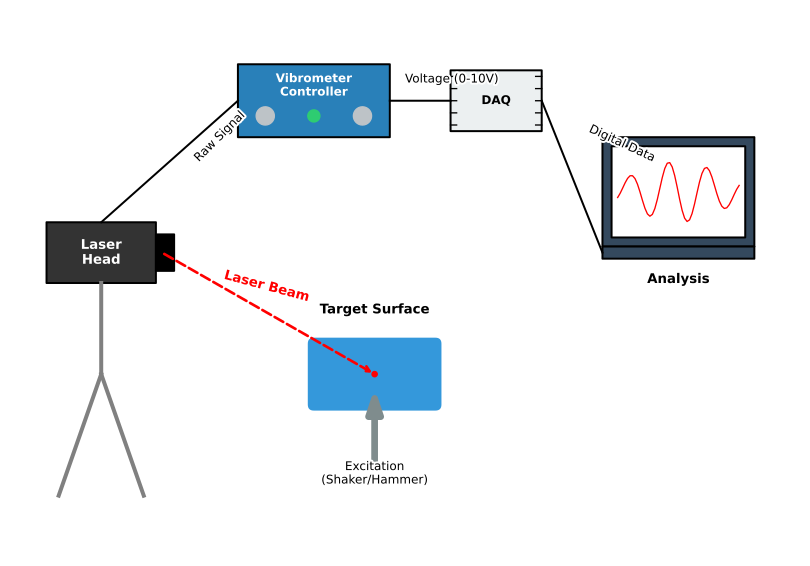
Now that we understand the physics, let’s look at the hardware. A standard modular LDV system is split into two main units: the Eye and the Brain.
The Optical Sensor Head (The “Eye”)
This contains the laser, interferometer, and lenses.
- Why Focus Matters: The laser must be tightly focused on the target to get enough reflected light back. This maximizes the Signal-to-Noise Ratio (SNR).
The Controller & Decoder (The “Brain”)
This unit processes the raw signal. Depending on your needs, you can swap out different decoder cards:
- Velocity Decoder: Uses FM demodulation. Ideal for 90% of general vibration tasks (typically > 0.5 Hz).
- Displacement Decoder: Counts interferometric fringes directly. Essential for:
- DC (static) displacement – Unlike accelerometers, LDV can track slow drifts.
- Ultra-low frequency motion (< 0.5 Hz).
- Precise positioning tasks (e.g., hard drive head alignment, semiconductor lithography).
When to Switch Decoders?
If your vibration contains frequencies below 1 Hz or you need absolute position tracking, use the Displacement Decoder. For higher-frequency vibrations (> 1 Hz) where relative velocity matters, the Velocity Decoder is faster and more robust.
Typical LDV Specifications
| Parameter | Typical Range |
|---|---|
| Displacement Resolution | 0.1 pm – 1 nm |
| Velocity Range | 0.01 μm/s – 30 m/s |
| Frequency Bandwidth | DC – 24 MHz (up to 1.5 GHz for specialized units) |
| Working Distance | 0.1 m – 300 m |
| Laser Type | He-Ne (633 nm) or Diode (1550 nm) |
Getting the Best Signal: Practical Guide
Getting a clean LDV signal isn’t magic—it’s about optimizing the optical path. Follow this workflow to ensure reliable data every time.
The Setup Phase (Pre-Measurement)
Before turning on the laser, ensure your physical setup is rigid.
- Tripod & Mounting: Use a heavy-duty tripod or magnetic base. Any vibration in the laser head itself will appear as noise in your data.
- Geometry Check:
- Stand-off Distance: Ensure you are within the optimal working distance for your specific lens.
- Angle of Incidence: Aim for $0^\circ$ (perpendicular). As the angle increases, the return signal drops effectively by $\cos(\theta)$.
- Tools: Use a spirit level to align the head and a tape measure to verify distance.
Optimizing the Optical Path
Once the beam is on, maximize the light returning to the sensor (“Backscatter”).
- Focus is King: Adjust the focus ring until the “Signal Level” bar on the controller is maximized.
- Tip: Use a camera lens attachment to zoom in on the focal point and a screen to display it for easier adjustment. The smaller the speckle pattern, the better the focus.
- Surface Preparation:
- Mirror Surfaces: Avoid them. They reflect the beam away unless perfectly aligned.
- Matte Surfaces: Ideal. They scatter light in all directions (diffuse reflection), ensuring some returns to the lens. Using retro-reflective tape or white developer spray is standard practice.
- Transparency Check: For thin/transparent samples, place a sheet behind them. If you see a bright dot on the sheet, you are losing signal through the sample.
Signal Quality & Troubleshooting
If the signal is still weak or noisy:
- Speckle Noise: If data looks like “spikes” or “dropouts,” you are likely hitting a dark speckle. Solution: Slightly move the laser spot by a fraction of a millimeter or apply tracking filters.
- Signal Clipping: If the controller blinks “Overload,” your vibration amplitude exceeds the current range. Solution: Switch to a less sensitive range (e.g., from 10 mm/s/V to 20 mm/s/V).
- Thermal Drift: Lasers need stability. Pre-heat for 15-20 mins. If the head gets hot during long tests, trip the beam for 10-15 mins to cool down without powering off the system.
- Crosstalk: Ensure only the active decoder channel is enabled.
Adjustment Strategy
It is wise to only adjust the angle of incidence and height first, as these are common culprits for low signal. Once the Controller settings are valid for your range, try to maintain them.
LDV vs. Accelerometers: Making the Choice
Now that you understand both the capabilities and limitations of LDV, how does it compare to the traditional workhorse—the piezoelectric accelerometer?
| Feature | Piezo Accelerometer | Laser Doppler Vibrometer |
|---|---|---|
| Contact | Physical mounting (glue/screw) | Non-contact (laser beam) |
| Mass Loading | Adds mass (affects small structures) | Zero (pure light) |
| Frequency Range | Typically < 20 kHz | DC to > 1 GHz |
| Setup Time | High (cabling & mounting) | Low (point & shoot) |
| Cost | Low ($) | High ($$$) |
| Sensitivity | Good for general purpose | Extreme (picometer resolution) |
Quick Decision Guide
| Your Situation | Recommended Tool |
|---|---|
| Heavy machinery, routine monitoring | Accelerometer |
| Object < 1 gram (MEMS, insects) | LDV |
| Rotating parts (turbines, tires) | LDV |
| Frequency > 20 kHz or ultrasonic | LDV |
| Static displacement / DC drift | LDV (Displacement Decoder) |
| Limited budget, simple setup | Accelerometer |
| Non-contact required (hot/sterile) | LDV |
Real-World Applications
Because it is contactless, LDV can go where accelerometers cannot:
Micro-Scale (MEMS & Bio):
- Challenge: Objects like an insect’s ear or a MEMS gyroscope are lighter than a grain of sand.
- LDV Solution: Zero mass loading ensures the measurement doesn’t alter the physics.
Macro-Scale (Civil Structures):
- Challenge: Monitoring a bridge span where running cables is expensive or dangerous.
- LDV Solution: Measure continuously from hundreds of meters away using a telescope lens.
Automotive (NVH):
- Challenge: Rotating parts (tires, crankshafts) cannot have wires attached.
- LDV Solution: The laser beam stays focused on the rotating surface (or uses a rotational vibrometer) to separate rotation from vibration.
Advanced: 3D Scanning LDV
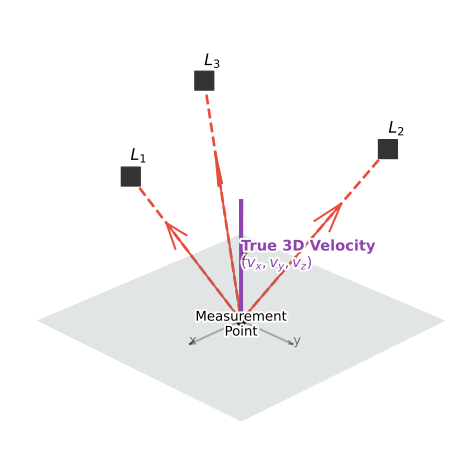
A single laser beam only measures motion along one line (1D). But real objects move in 3D. A brake disc doesn’t just vibrate in/out; it twists and shears.
The Solution: 3D Scanning LDV uses three independent laser beams focused on the same point from different angles.
| Feature | Single-Point LDV | 3D Scanning LDV |
|---|---|---|
| Measurement | 1D (Out-of-Plane only) | 3D (X, Y, Z vectors) |
| Best For | Pistons, speakers | Brake squeal, complex modes |
| Insight | Amplitude only | True spatial motion separation |
Each laser measures velocity along its own line-of-sight direction ($\hat{e}_1$, $\hat{e}_2$, $\hat{e}_3$). The true velocity vector $\vec{v}$ is recovered by solving:
$$ \begin{bmatrix} v_{1} \\ v_{2} \\ v_{3} \end{bmatrix} = \begin{bmatrix} \hat{e}_{1x} & \hat{e}_{1y} & \hat{e}_{1z} \\ \hat{e}_{2x} & \hat{e}_{2y} & \hat{e}_{2z} \\ \hat{e}_{3x} & \hat{e}_{3y} & \hat{e}_{3z} \end{bmatrix} \begin{bmatrix} v_{x} \\ v_{y} \\ v_{z} \end{bmatrix} $$
This separates “breathing” modes (surface moving like a speaker) from “shear” modes (surface rubbing sideways)—critical for solving complex noise issues like brake squeal.
Conclusion
Laser Doppler Vibrometry transforms light into a precise measuring tool. By mastering the Doppler shift and interferometry, it allows us to “touch” the untouchable—measuring the heartbeat of a microscopic sensor or the sway of a skyscraper without ever laying a finger on them.